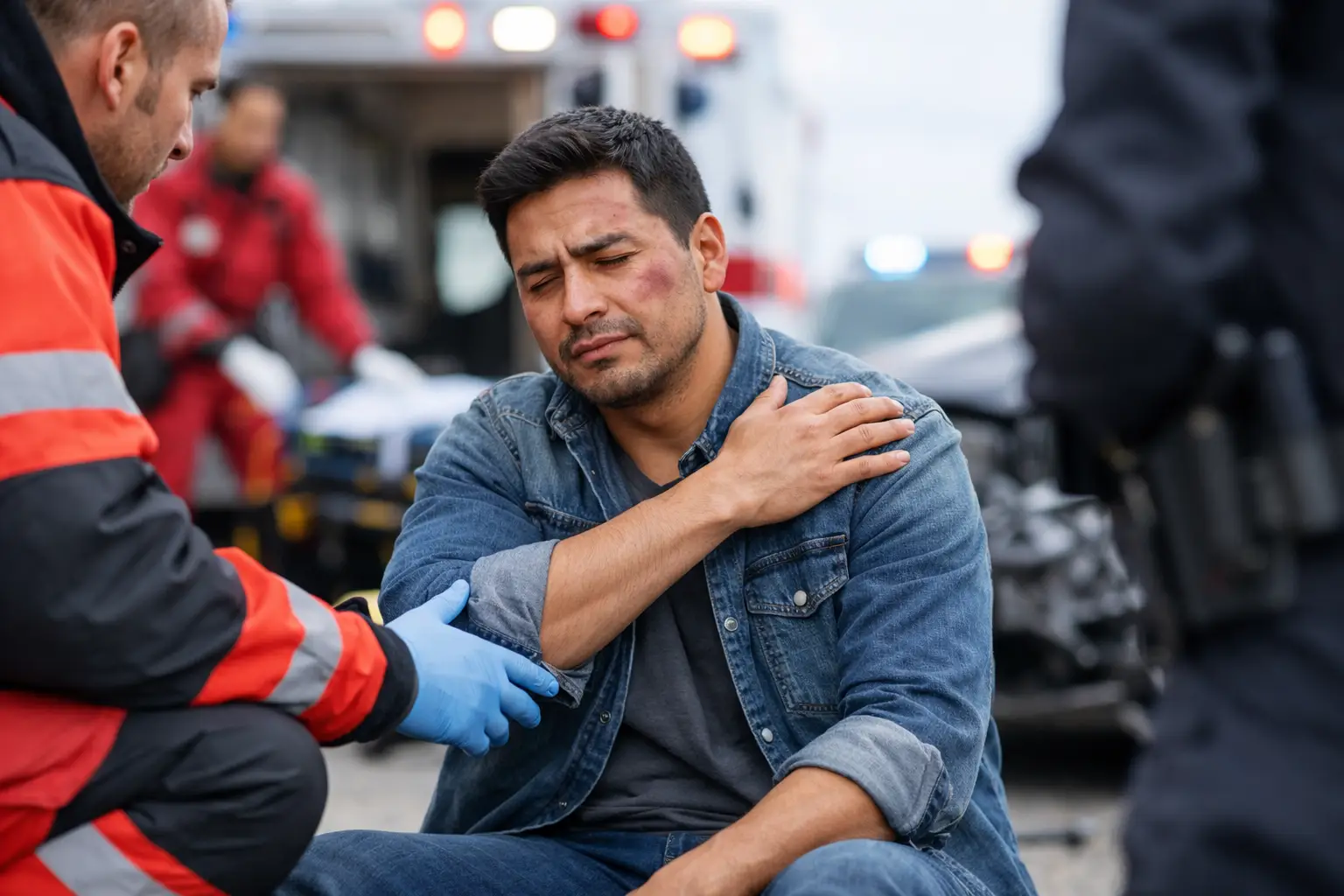
You were injured, your body hurts, you don't know who will pay for the hospital, and on top of that the usual fear appears: if I speak, if I claim, if I ask for help, will I get into trouble because of my status? If you're wondering what happens if I don't have papers and I suffered an accident, the short answer is this: you still have rights. And that detail changes much more than most people believe.
After an accident, many Hispanic people stay silent out of fear. Fear of the police, the insurance, the employer, the hospital, of giving their name, of signing something without understanding it. That silence benefits others, not you. The insurance company benefits if you don't claim. The responsible party benefits if you accept little. An irresponsible boss benefits if you think that because you don't have papers, you can't demand anything. But an injury doesn't stop being an injury because of the victim's immigration status.
What happens if I don't have papers and I suffered an accident in the U.S.
In many cases, you can file a claim for injuries, medical expenses, lost wages, and other damages, even if you don't have regular immigration status. This may apply in car accidents, work accidents, falls, construction injuries, and other cases of negligence. What matters first is not your status, but how the accident happened, who was at fault, and what evidence exists.
That doesn't mean all cases are the same. There are states with different rules, insurance companies that are more aggressive than others, and situations where one party tries to use fear as pressure. That's why it's good to act quickly and carefully. The sooner everything is documented, the less room there will be for excuses, changed versions, or tactics to weaken your case.
There's also something important: seeking medical attention is not a luxury, it's a necessity. Many people endure pain to avoid leaving a trace or to avoid spending. The problem is that decision can affect both your health and your claim. If there's no medical evaluation, it will be easier later for the insurance to say you weren't that bad or that the injury came from somewhere else.
Your rights don't disappear because you don't have papers
There's a very common mistake in our community: thinking that claiming compensation is a privilege reserved for citizens or residents. It's not. If another person, a company, or an employer caused or contributed to the accident, you may have the right to demand responsibility.
In a traffic accident, for example, the at-fault driver's policy exists to cover damages caused to third parties, not just to people with certain immigration status. In a work accident, there may be rights under the workers' compensation system or even additional claims if there was negligence by third parties. In a construction site, things can become more complex, but no less serious.
What does change is the way you should protect yourself. If you don't have papers, it's not good for you to improvise, sign documents without understanding them, or say too much to adjusters. Don't accept quick cash to "settle it between us" either. That type of agreement usually benefits the other side and leaves you alone with the bills.
What to do right after the accident
First, seek medical attention. If there is pain, dizziness, a blow to the head, bleeding, or difficulty moving, don't downplay it. Sometimes the serious injury doesn't fully hurt at first.
Next, try to gather evidence. Photos of the location, of the vehicles, of your injuries, of defective equipment, or of any dangerous condition. If there were witnesses, write down their information. If it was a car accident, get the report if police were involved. If it was at work, report the incident as soon as possible and leave a written record if you can.
Then comes a key part: don't give recorded statements to the insurance without legal guidance. They may call you in a friendly tone, but their job is not to protect you. Their job is to pay as little as possible. A poorly explained phrase, a wrong date, or an omitted injury can complicate you a lot.
And one more thing: save everything. Bills, prescriptions, medical reports, messages with the employer, days lost from work, transportation receipts, emails, and any paper related to the accident. What seems like a detail today can prove the real impact of the accident tomorrow.
If the accident was at work
Here fear is usually double. Not only because of immigration status, but also because of the possibility of losing your job. Many Hispanic workers endure serious injuries for fear of retaliation. But staying silent doesn't make the damage disappear.
In many states, injured workers may have rights even if they don't have papers. If you fell, were hit by machinery, suffered a back injury, burns, or an accident on a construction site, it's worth checking if workers' compensation applies, if there was a lack of safety measures, or if a company outside the employer had responsibility.
There are cases where the employer tries to avoid reporting, offers money under the table, or tells you that if you speak up, they'll replace you. That pressure is a red flag. When a company knows it acted wrongly, it usually bets on the worker's fear. Don't complicate your life trying to solve alone something that could affect you for months or years.
If it was a car accident and you don't have a license
This is another frequent concern. Not having a license doesn't automatically erase your right to claim if another person caused the crash. These are different issues. Accident responsibility is analyzed based on the facts: who ran the red light, who was distracted, who changed lanes, who drove recklessly.
That said, the other party may try to use the lack of a license to pressure you or confuse you. That's why it's so important not to discuss the case without support. An administrative detail shouldn't hide the negligent conduct of the responsible party.
If you were also a passenger, the situation is usually even clearer. An injured passenger can have the right to claim against the at-fault driver, and in some cases even against multiple policies, depending on how the accident occurred.
What you shouldn't do if you don't have papers and suffered an accident
There are mistakes that repeat a lot and cost dearly. One is disappearing after the accident and hoping to see if the pain goes away on its own. Another is trusting that the insurance "will do the right thing." It's also a mistake to post too much on social media, especially photos or comments that could be used to downplay your injuries.
Nor is it advisable to lie. Not about how the accident happened, not about your symptoms, not about medical history. The truth well presented protects more than a made-up story. A solid case doesn't need embellishments, it needs evidence, consistency, and speed.
And if someone tells you that because you don't have papers you can't do anything, be careful. Sometimes that lie comes from the responsible party, the employer, or even from people who have opinions without knowing. Don't make such a serious decision based on others' fear.
When to talk to a lawyer
As soon as possible, the better. Not because all cases end in litigation, but because the first hours and first days usually define many things. What evidence is preserved, what is said to the insurance, what medical treatment is documented, what deadlines are activated, and what mistakes are avoided.
An accident lawyer who assists in Spanish can help you understand your options straightforwardly. They can review whether there is an available policy, whether the employer violated regulations, whether there were third parties responsible, and how to protect your information as the case moves forward. On a platform like Conexión Legal, many families are looking for exactly that: to speak clearly, quickly, and in their language.
There's also a practical matter. Most injured people are not in a position to fight alone against insurance companies, forms, calls, and bills while trying to recover. Having legal support doesn't erase the accident, but it can lift an enormous weight off your shoulders.
The fear is real, but letting your case pass also has consequences
Waiting too long can close doors. Evidence is lost, witnesses disappear, memories change, and legal deadlines don't stop because you're afraid or uncertain. That's hard, but it's worth saying clearly.
If today you're thinking "it's better I do nothing," ask yourself something more useful: who wins if I stay silent? It's almost never you. If you suffered an injury and another person or company was at fault, you deserve to understand your rights and decide with information, not panic.
You don't need to have all the answers today. What you need is to not be left alone with the fear. Talking to someone who understands these cases, who explains things to you in Spanish, and who understands what's at stake can be the first step to regaining a little control when everything seems chaotic.