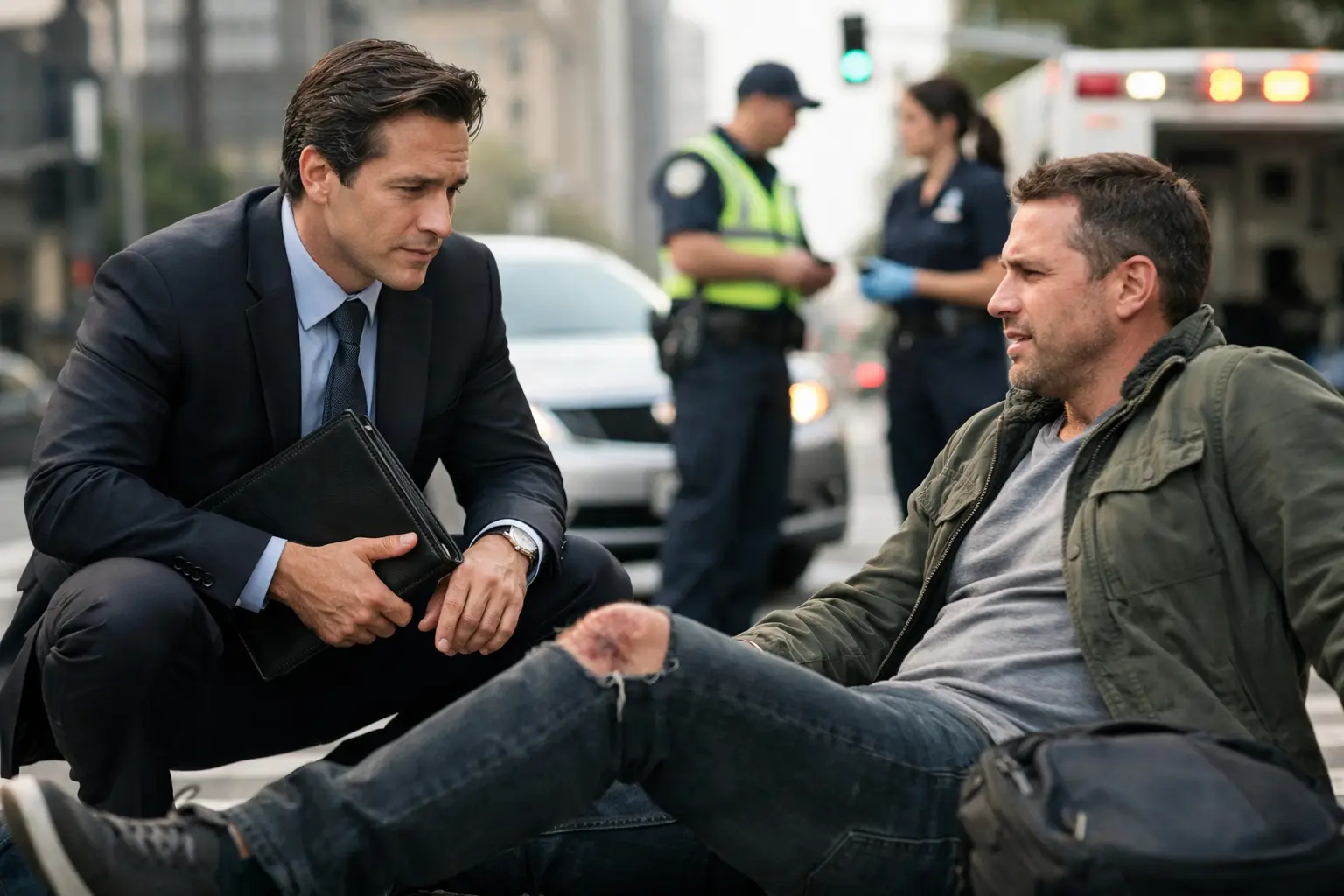
You get hit by a car at an intersection, you're thrown several meters, the ambulance arrives and, while you're trying to understand what happened, the insurance company is already thinking about paying as little as possible. That's when a pedestrian accident lawyer stops being a distant option and becomes urgent help. If you were injured while walking, you're not exaggerating by seeking legal support quickly. You're protecting your health, your income, and your right to claim.
Pedestrian accidents are usually serious for a very simple reason: the pedestrian has no protection against impact. A hit that might seem "minor" to a driver can leave a person with fractures, spinal injury, head trauma, or weeks unable to work. And while you're trying to recover, the other party can start building a version of events that doesn't favor you.
What a pedestrian accident lawyer does
A pedestrian accident lawyer doesn't just file papers. Their real job is to defend your case from the beginning so you don't burden yourself with mistakes that cost dearly later. That includes reviewing the police report, locating cameras, talking to witnesses, gathering medical records, calculating damages, and negotiating with the insurance company from a strong position.
It also serves something equally important: taking pressure off you. After being hit by a car, many Hispanic people in the United States feel lost. They don't know if they should talk to the insurance, if they can claim even if they crossed outside the crosswalk, or if their immigration status matters. The answer, in many cases, is that yes they can seek help and yes they should do it as soon as possible.
When the case is well prepared, you can claim the cost of medical care, loss of income, physical pain, rehabilitation, and other damages related to the accident. But each state has different rules, and every detail matters. That's why it's not worth waiting to see if the situation "sorts itself out."
When you need a lawyer after being hit by a car
There are cases where calling a lawyer cannot be delayed. If you suffered fractures, surgery, head injury, persistent back pain, or any injury that prevents you from working normally, you need immediate legal advice. The same applies if the driver fled the scene, if the police assigned you part of the blame, or if the insurance company already called you to request a statement.
It's also worth seeking help if the hit-and-run happened in a parking lot, an intersection, a school zone, or while you were going to work. These are situations where there can be several sources of liability and it's not always obvious who should be held responsible. Sometimes it's not just the driver involved. There could be a company, an employer, a property owner, or even a third party that contributed to the accident.
Waiting can weaken your case. Cameras get erased, witnesses forget, and documents are lost. Also, when an injured person takes time to receive medical attention or seek representation, the insurance company often uses it to say the injury wasn't that serious.
What you should do right after the pedestrian accident
If you can move safely, ask for help and call 911. The priority is your health, but also creating an official record of the accident. Accepting an early medical evaluation not only protects your body. It also creates a key record of the impact and your injuries.
After that, try to get the driver's information, photos of the scene, witness information, and any visible images of the vehicle. If you can't do it because of your condition, ask someone you trust to help you. Don't argue about who was at fault on the street or sign anything in the heat of the moment.
A very common mistake is talking too much with the other insurance company. Another frequent mistake is accepting a quick amount because there are urgent bills. The pressure is understandable, but an early offer often comes before knowing the true extent of your injuries. If you accept too soon, it can later be too late to claim what you really need.
Who is at fault in a pedestrian accident
Not all hit-and-runs are the same. Sometimes the driver was distracted with their cell phone, turned without yielding the right of way, or was driving at excessive speed. Other times the pedestrian crossed outside the marked area or entered the roadway unexpectedly. And even so, that doesn't automatically mean there's no case.
In many U.S. states, rules of shared fault or comparative negligence apply. In simple terms, more than one person can share responsibility. That matters because the other party will try to blame you entirely to pay less or not pay anything. A lawyer knows how to argue those claims with evidence, not guesses.
Here's a point that worries our community a lot: the fear of not claiming because you're an immigrant or because you don't want trouble. Don't complicate your life by carrying that fear alone. In personal injury cases, your right to seek legal advice doesn't disappear because of your immigration status. What can disappear if you wait too long is the strength of your case.
What compensation can be claimed
Each case depends on the severity of the injury, recovery time, and how your life changed after being hit. It's not just the hospital bill. Many people lose weeks or months of salary, need physical therapy, medication, transportation to appointments, and support for daily tasks they used to do without help.
In addition to direct economic harm, there can be physical suffering, permanent limitations, and emotional impact. Being hit by a car doesn't end the day of impact. Sometimes it starts a chain of problems: anxiety when walking, chronic pain, inability to return to heavy work, or need for prolonged treatment.
That's why a well-handled case doesn't just look at the present. It also looks at what's coming. If your injury is going to affect you in six months or a year, that should be evaluated from the start.
How a firm that serves you in Spanish works
When you talk to a legal team that understands your language and your reality, everything changes. You don't have to guess at terms, you don't feel pressured to say "yes" to something you didn't understand, and you can clearly explain how the accident happened. That trust matters a lot, especially in moments of pain and stress.
On a platform like Conexión Legal, the goal is to quickly connect you with accident lawyers who can take your case based on your state and type of injury. That speed matters. If you're assigned legal support in less than 24 hours, there's more room to preserve evidence, guide your medical care, and respond to the insurance company firmly from the start.
There's also a practical advantage that many families need to hear: in this type of case, it usually works with the no win, no fee model. That reduces the financial barrier and allows you to ask for help without paying upfront fees while you're injured and without income.
Mistakes that can damage your claim
The first is downplaying the pain and not going to the doctor. The second is giving a recorded statement to insurance without advice. The third is posting on social media photos or comments that are later used against you. And the fourth, very common, is thinking that because you were walking outside the crosswalk you have no rights.
Reality is rarely that simple. There are cases where the driver could have avoided the hit and didn't. There are others where visibility, speed, signage, or distraction were decisive factors. What you need isn't to guess. You need someone to review the facts with experience.
Pedestrian accident lawyer in the U.S.: why to act today
Laws change by state and deadlines for claiming aren't forever. California doesn't work the same as Georgia, New York, New Jersey, Illinois, or Pennsylvania. That's another reason to act soon. What works in one city may not work the same way in another.
If you or a family member was hit by a car, this is not the time to stay silent or blindly trust the insurance company. Your case deserves serious attention, in Spanish and without beating around the bush. The sooner you ask for help, the better your chances of organizing your treatment, protecting the evidence, and claiming forcefully.
If you're in pain today, confused, or worried about bills, there's something you can do right now: talk to someone who explains your options clearly. Sometimes the first call doesn't fix everything, but it does change the course of what comes next.