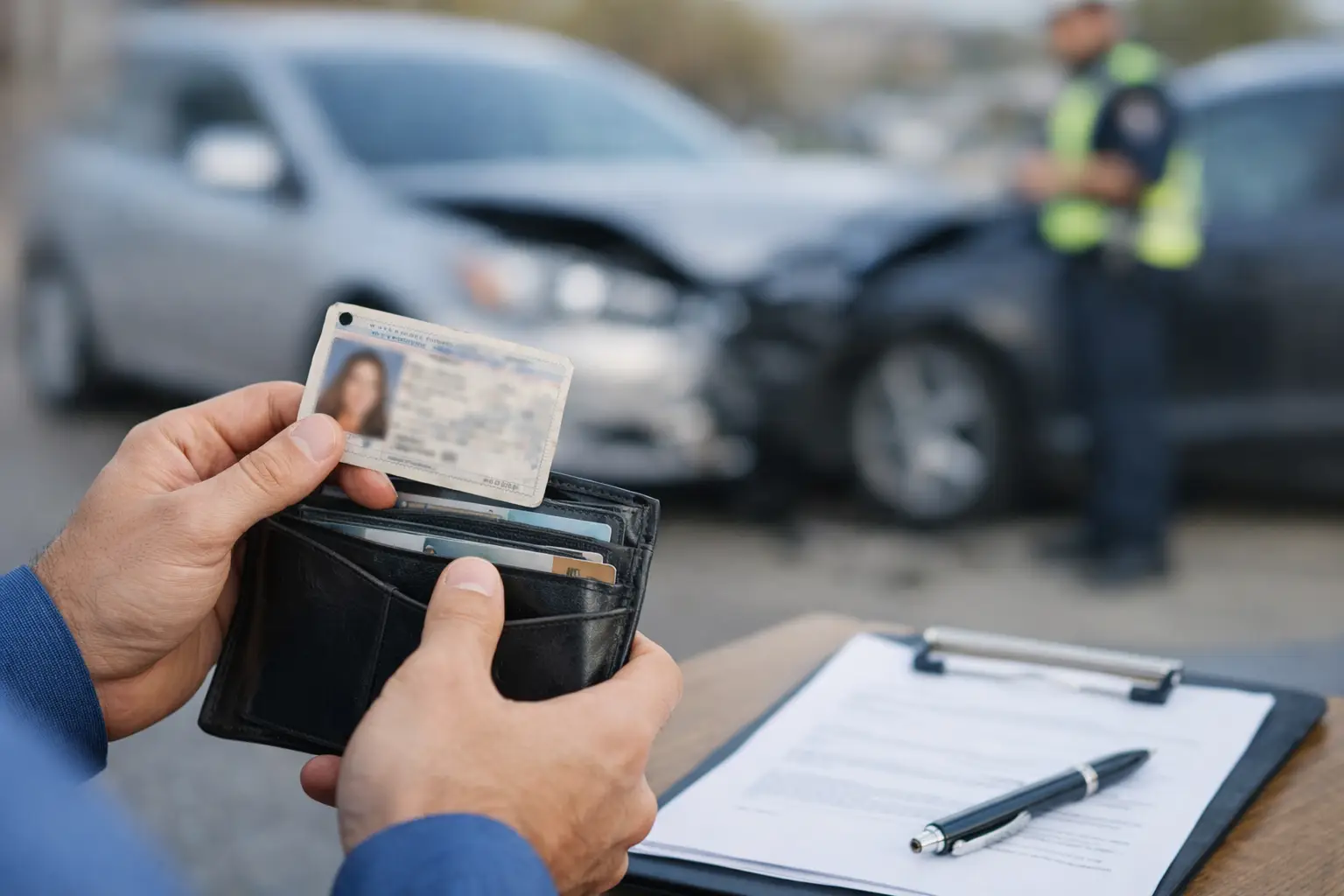
Another car hits you, you end up with neck pain, a destroyed vehicle, and on top of that, panic sets in: your license isn't valid. At that moment many people stay silent, don't seek medical attention, or accept any low offer from the insurance company. But the real question is this: can I claim without a valid license? In many cases, yes. And staying quiet out of fear can cost you much more than asking for help in time.
Having an expired license, a suspended license, or not having renewed it doesn't automatically mean you lose the right to claim for your injuries. What matters is how the accident happened, who was at fault, what damages you suffered, and what evidence exists. Insurance companies know that this point scares many Hispanic families, and that's why they use it to pressure, confuse, or close cases quickly.
Can I claim without a valid license in an accident?
Yes, you often can claim without a valid license. Not having a valid license can complicate the case, but it doesn't erase your rights with a single stroke. If another driver hit you because they were distracted, ran a red light, or drove negligently, the fact that your license wasn't valid doesn't magically make them innocent.
Here there's an important distinction. One thing is an administrative violation related to your license and something entirely different is civil liability for the accident. They're connected topics, but not identical. The insurance company will try to mix them because it benefits them, but a personal injury case is analyzed based on fault, damage, and the relationship between the two.
For example, if you were stopped at a red light and get hit from behind, the status of your license is usually not the cause of the crash. On the other hand, if the other party claims that your driving contributed to the accident, then the discussion will be more complex. There, the details matter a lot.
What does change when you don't have a valid license
Saying that yes you can claim doesn't mean everything will be easy. There are scenarios where the lack of a license gives ammunition to the insurance company. Most commonly, they'll try to present you as an irresponsible person to weaken your version of events. They can also scrutinize every document, every statement, and every detail in the police report.
If your license expired just a few days ago, it's not the same as going a long time without renewing it. A suspended license for an administrative reason is also different from revocation for a serious violation. Those differences can influence the strategy of the case, although they don't necessarily destroy your claim.
Also, each state has its own rules about liability, mandatory insurance, and comparative fault. In some states, if it's shown that your conduct contributed to the accident, compensation can be reduced. In others, you could be barred if your percentage of fault exceeds a certain limit. That's why it's not wise to assume anything without reviewing the concrete facts.
If you weren't at fault, your case still has value
This is the point that matters most. If another driver caused the accident and you suffered injuries, medical expenses, days without work, or physical pain, your case can move forward even if you didn't have a valid license. The key is proving two things: that the other party acted negligently and that your damages are real.
Insurance companies usually bet that you won't claim. They hope fear will paralyze you, especially if you're Hispanic, if you don't speak English fluently, or if you're worried that any problem with documents will complicate things further. Don't do that work for them for free.
What the insurance company uses to deny or lower your payment
When an insurance company discovers that you didn't have a valid license, it will try to use it as leverage. Sometimes it will say you shouldn't have been driving. Other times it will hint that, for that reason alone, you don't deserve compensation. That's not always true.
What can really affect your case is if they manage to connect the lack of a license to the cause of the accident. If that connection doesn't exist, their argument loses strength. That's why the police report, photos, witnesses, medical history, and even traffic cameras can be decisive.
They'll also check if you were insured, if the vehicle was registered, and if there are contradictions in your statements. Not because all that automatically cancels your claim, but because they're looking for any loophole to pay you less. Their goal is not to protect you. Their goal is to save money.
What to do if you're asking yourself "can I claim without a valid license"
The worst thing you can do is wait. After an accident, time works against you. Witnesses forget details, videos get deleted, car damage changes, and insurance starts building their version before you do.
First, seek medical attention as soon as possible. Even if you think it was a minor hit, there are injuries that feel serious hours or days later. Plus, if you wait too long, the insurance company can say you weren't that bad off or that your injuries come from something else.
Next, save everything. Photos of the scene, the car, your injuries, the police report, receipts, prescriptions, messages, and any communication from insurance. If there were witnesses, try to get their information. Every piece of evidence counts.
And there's something else: don't give lengthy statements or sign agreements quickly without legal guidance. When you're nervous, in pain, and scared about the license issue, it's easy to say something that they can use against you later. A poorly explained phrase can complicate a case that actually had a solid foundation.
What if the police gave me a ticket?
Getting a ticket doesn't automatically mean you lose the right to claim. The ticket is one matter, and your injury is another. Of course it can influence how responsibility is discussed, but it doesn't equal automatic defeat.
There are people who receive a citation for driving with an expired license and still keep a valid claim against the driver who caused the crash. Everything depends on the facts. That's why it's good to look at the complete file and not just the ticket.
Cases where there may be more obstacles
There are delicate situations. If you were driving recklessly, if you were under the influence of alcohol, or if your version changes several times, the problem is no longer just the license. There the defense will have more arguments to question the entire case.
It can also become complicated if you weren't the vehicle owner, if the car wasn't insured, or if there was an applicable coverage exclusion. In those scenarios there can still be options, but you need to review the policy, the state where the accident occurred, and who was involved.
The important thing is not to get confused: complicated doesn't mean impossible. Many people abandon valid cases just because someone from the insurance company told them there was nothing to be done. And that, simply, is not always true.
Your immigration status doesn't define your rights
After an accident, many people don't just think about the license. They also feel fear about their immigration status. That fear is real, but it shouldn't prevent you from asking for help. An accident is an accident, and your injuries are no less valuable because of your language, your origin, or your papers.
If you suffered damages, you need clear and quick guidance. At Conexión Legal we understand that fear because we see it every day in our community. That's why the conversation should focus on what happened, your injuries, and how to protect your case from the first moment.
When talking to a lawyer can change everything
If the insurance company has already called you several times, if they're blaming you for the accident, if your injuries keep you from working, or if you don't know how to respond about the license issue, don't complicate your life. A car accident attorney can review whether the lack of a license really affects liability or if it's just a tactic to scare you.
That matters because the strategy changes based on the state, the type of accident, and the available evidence. A rear-end collision is not the same as an accident at an intersection. A recently expired license is not the same as a prolonged suspension. And minor injuries are not the same as long-term medical treatment.
When someone tells you flatly that you can't claim just because you don't have a valid license, be suspicious. The law rarely works with such simple statements. The details move the case.
If today you're still asking yourself "can I claim without a valid license," the most honest answer is this: many times yes, but you need to act fast and not let fear decide for you. Your priority should be to take care of your health, protect the evidence, and get guidance before the insurance company closes the door you can still open.