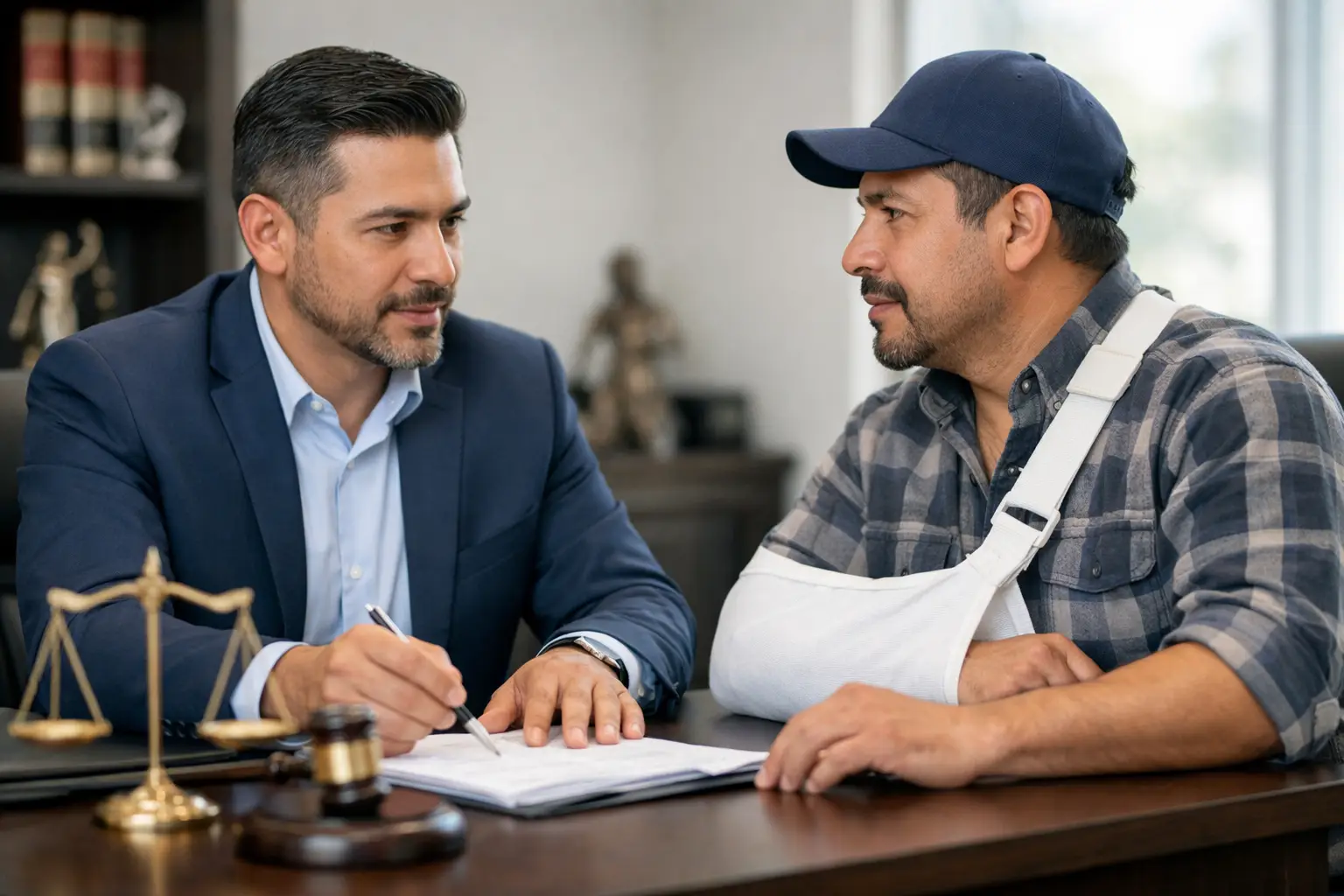
You get injured at work, the pain won't even let you sleep, and yet the company or insurer starts asking questions as if you were the problem. At that moment, having a Hispanic workers' compensation attorney is not a luxury. It's a way to protect your health, your wages, and your future without getting lost in a system that often intimidates more than it should.
When a Hispanic worker suffers a work accident in the United States, the same fears almost always appear. What if I get fired? What if I don't speak enough English to explain what happened? What if my immigration status complicates everything? The reality is that a work injury can give you the right to medical care, partial income replacement, and other benefits. The problem is usually not just the accident. The problem is being left alone against the employer, the insurance, and the paperwork.
What a Hispanic workers' compensation attorney does
A workers' compensation attorney is not just there to fill out papers. His job is to defend your version of the facts, gather medical evidence, monitor deadlines, and fight if the insurer tries to reduce or deny the case. If he is also Hispanic or truly serves in Spanish, there is an advantage that weighs a lot: you can tell what happened with clarity, ask questions without embarrassment, and understand each step before signing anything.
That matters more than it seems. Many workers accept errors in their accident report, minimize symptoms, or return to work early because they did not understand the process well. Then the consequences come: insufficient treatment, incomplete checks, or a denial based on information poorly explained from the beginning.
A good attorney also knows when a case is not limited to workers' compensation. Sometimes the injury occurred because of a fall on a construction site, a defective machine, a company vehicle, or the negligence of a third party. In those scenarios, there may be additional claims. That is where quick advice changes the strategy completely.
When you should call a Hispanic workers' compensation attorney
You don't need to wait for the case to get complicated to seek help. In fact, the sooner you talk to an attorney, the better protected you will be. If the accident was recent, if you have already reported the injury and no one explains what comes next, or if the employer started pressuring you to not miss work, that is the time.
You should also ask for help if the pain gets worse over the days, if the assigned doctor doesn't listen to you, if you are forced to return to work with restrictions that you cannot meet, or if you received a denial letter. And if you were fired, your hours were cut, or you noticed retaliation after reporting the injury, don't let it go. That is not a simple administrative inconvenience. It can be a violation of your rights.
There are workers who hesitate because they think their injury "is not that serious." That calculation can be expensive. A back, shoulder, knee, or neck injury can seem manageable the first week and turn into months of disability. The same happens with head blows, burns, repetitive strain injuries, or respiratory problems from work exposure.
What many Hispanic workers don't know
One of the biggest obstacles is not legal. It is misinformation. There are employees who believe they can only claim if the employer was at fault. It's not always the case. In many states, workers' compensation works precisely to cover injuries that occurred at work, even if there was no direct intention to cause harm.
Another common fear is thinking that asking for benefits makes you a problem for the company. It shouldn't. If you were injured while working, exercising your rights is not abusing the system. It is using a protection created for workers like you.
There is also much silence around immigration status. But a work injury stops being an injury because the person doesn't have documents or is in a delicate immigration situation. What is important is to receive immediate guidance and not let fear paralyze you. Staying silent out of fear only benefits whoever wants to close the case quickly and paying less.
How the insurer usually tries to defend itself
Insurers rarely will openly tell you they are trying to pay less. They do it with tactics. Sometimes they question whether the injury occurred at work. Other times they claim you already had a pre-existing condition. They can also delay medical authorizations, send the worker to evaluations that minimize the damage, or use your own words against you if you gave a statement without legal advice.
That is why it is not advisable to improvise. An attorney reviews medical records, accident reports, witnesses, cameras, messages, and employment history to build a solid version. If there are inconsistencies, he corrects them in time. If the insurer denies the case, he prepares the appeal and represents you in hearings or negotiations.
Not all cases end the same way. Sometimes the conflict revolves around medical treatment. Other times the problem is temporary disability, permanent disability, or the attempt to close the case before knowing the real scope of the injury. Each detail changes what it is advisable to do.
What to look for in a Hispanic workers' compensation attorney
It is not enough that someone "speaks some Spanish." You need clear, quick, and serious attention. A law firm or legal platform that understands the reality of the Hispanic community understands better the fear of losing income, family pressure, and the urgency of getting answers today, not in two weeks.
Look for specific experience in work accidents, Spanish communication from start to finish, and availability to explain your case straight. It is also good to ask who will actually handle your file, how long it takes to respond, and how they will keep you informed. If from the first call you feel ignored or confused, that is a bad sign.
Another key point is the payment model. Many people do not seek help because they think hiring an attorney is impossible. In these types of cases, it is common for representation to work under fees contingent on the outcome of the case. That reduces the barrier to entry and allows you to act quickly when you need it most.
Common work injuries in the Hispanic community
In construction, warehouses, factories, cleaning, kitchens, transportation, and landscaping, injuries are more common than many admit. Falls from ladders or scaffolding, blows from objects, slips, cuts, fractures, hernias, back injuries, and machinery accidents appear over and over again.
There are also less visible but equally serious cases. Repetitive movements, exposure to chemicals, heat exhaustion, overexertion when carrying weight, and traffic accidents while working can give rise to a claim. The mistake is thinking that only a spectacular injury counts. Many long-term disabilities start with a "tolerable" pain that no one attended to in time.
If you work in California, Georgia, Illinois, New York, New Jersey, or Pennsylvania, for example, the procedures and deadlines may vary. That is why it is not advisable to rely on what happened to a coworker in another state. Your case depends on your facts, your medical history, and the rules where the accident occurred.
Speaking in Spanish changes the case
When an injured person understands what they sign, what they declare, and what they can demand, they make better decisions. That simple. The language barrier not only creates stress. It can affect the practical value of the case because it generates errors, omissions, and misunderstandings that are later costly to correct.
That is why Spanish-language service is not a convenient detail. It is a defense tool. Being able to tell how you fell, what machine failed, what the supervisor told you, or how the pain spread without searching for words in another language makes a real difference. And if your family also needs to understand the process, that closeness helps even more.
On platforms like Conexión Legal, that community-focused approach makes it possible to quickly connect Hispanic workers with attorneys who understand both the law and the human context surrounding the accident. Don't complicate your life trying to solve alone something that can affect your income and health for months.
The first step matters more than you think
After a work accident, every hour counts. Reporting the injury, seeking medical attention, keeping documents, and receiving early legal guidance can strengthen the case from the start. Waiting, on the other hand, usually benefits the company and the insurer.
If you were injured at work and don't know where to start, seek help as soon as possible. An attorney who serves you in Spanish can clarify your rights, stop abuses, and accompany you without feeling lost in the process. When work left you an injury, staying silent does not protect you. Acting on time does.