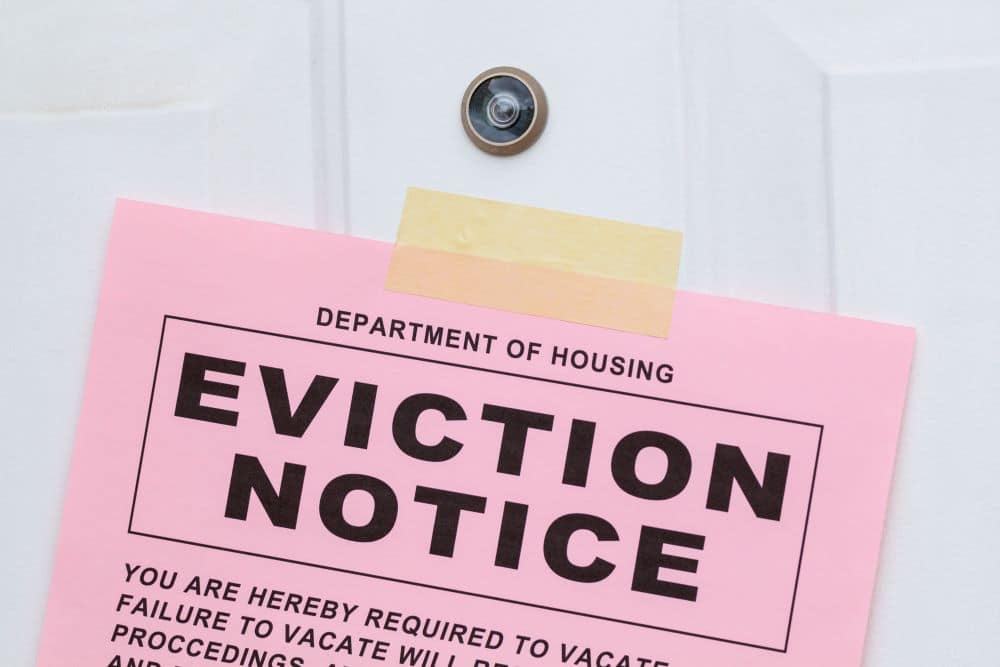
The owner of the house or apartment where you live may try to evict you, but first the court must issue a ruling, unless the landlord wins in court, they should not remove your belongings from the property or change the locks even if you owe back rent during the coronavirus pandemic.
The owner, also known as landlord or property owner, must first obtain a court order by which you will be notified of the court hearing and will have the opportunity to respond. Unless the court agrees with the eviction, your landlord cannot prevent you from entering your home, cut off heat or electricity, or force you to leave before the court decides your case.
If you find yourself in this situation, contact Conexión Legal by calling 1800 201 1220 so that a Spanish-speaking lawyer specializing in the laws that protect you during the COVID-19 pandemic can provide you with the best possible advice.
How Does It Work?
If your landlord wants to evict you, he or she can send you a Kapa Notice or a Notice to Quit. A Kapa Notice is an informal warning letter that explains what you did wrong, and asks you to stop doing it or pay for the damages you caused within 15 days.
If you receive one of these notices, try to discuss the problem with the landlord. If you fixed the problem within fifteen days, it is important that you gather as much evidence as possible. For example, if you hired someone to repair the damage or bought parts to repair it yourself, keep the receipts of payment. If the landlord says you let someone live with you without permission, obtain proof that that person lives elsewhere.
On the other hand, if the problem is not resolved in 15 days, your landlord can send you a Notice to Quit. A Notice to Quit is a legal document that asks you to leave by a certain date because you did not pay your rent; your landlord does not agree that you can continue living there; you violated the rental agreement or the law, for example, if you sold drugs or caused damage to your apartment; or your landlord wants to terminate a month-to-month rental contract or your rental contract has expired.
Your landlord cannot force you to leave if your rental contract has not expired. And, very importantly, you are not required to leave your home on the date indicated in the notice.
If the problem is not resolved and you do not leave, the landlord can ask the court to evict you. In that case, a sheriff will serve you with a Summons and Complaint. If this is the case, seek legal advice immediately by calling Conexión Legal.
Also, if you have a good reason to change the date of the trial, you must request a continuance at least 3 days before it. For that, fill out and file a Motion for Continuance (#JD-CV-21).
If you were unable to attend the trial for a very good cause, such as for example because you were hospitalized, you have 5 days to ask the court to reopen your case. For that, fill out and file a Motion to Open (#JD-CV-51). It would be good if you have documentation to prove the reason why you had to miss the hearing. Ask for help at the Court Services Center.
However; due to the recent health emergency unleashed by the coronavirus pandemic, it is important to mention that there are new laws that protect and safeguard you to temporarily freeze the payment of your rent and thus avoid your eviction in case you do not have the resources to pay for it.
When facing this situation, the best thing to do is to seek legal support immediately to resolve your situation. For this, contact Conexión Legal right now by calling 1800 201 1220 or send us a message via WhatsApp so that our team of expert Hispanic lawyers can provide you with the best free advice and later handle your case.
Follow the steps of the following form to schedule your free consultation appointment.