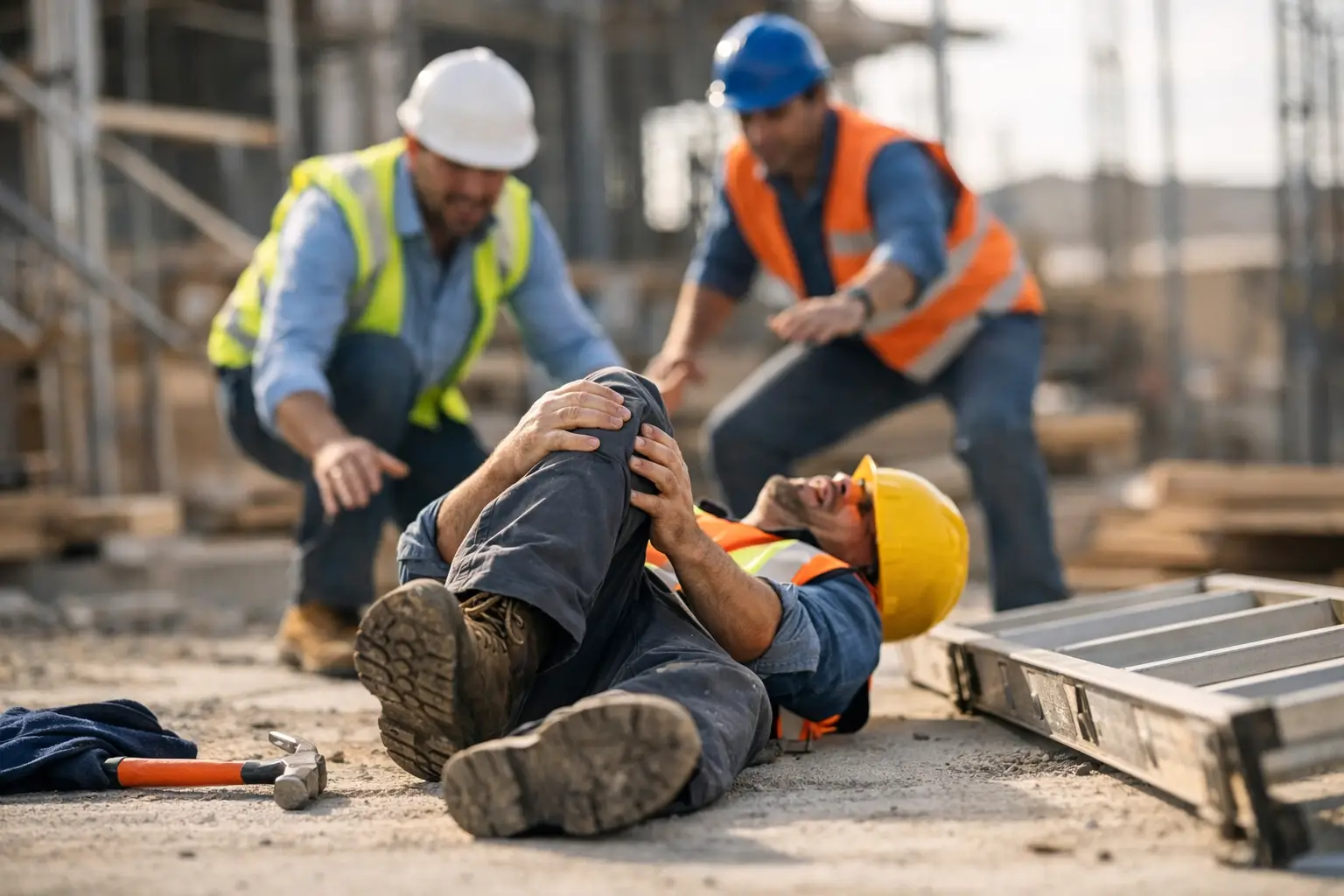
A fall injury at a construction site can change everything in seconds. You were working, doing your job, and suddenly you end up on the ground with pain, fear, and your head full of questions. Who pays for the hospital? What happens if you can't go back to work? What if your boss tries to downplay it? In that moment, acting fast is not an overreaction. It's protecting your health, your wages, and your future.
Fall injury at a construction site: why it's a serious case
Falls in construction are not minor accidents. Many occur from ladders, scaffolding, roofs, elevated platforms, or holes without proper protection. Others happen at ground level due to wet surfaces, scattered materials, or poorly marked areas. In either case, the result can be serious.
A fall at a construction site can cause fractures, back injuries, head damage, neck problems, and internal injuries that don't always show up immediately. There are workers who try to finish their shift out of necessity or fear of getting into trouble. That mistake later complicates the medical diagnosis and also weakens the case.
Additionally, not all accidents are resolved the same way. Sometimes workers' compensation comes into play. Other times there may also be a claim against a third party, such as a subcontractor, a scaffolding company, the property owner, or a manufacturer of defective equipment. That's the difference between accepting what they tell you at first or truly defending what you're entitled to.
What to do immediately after a fall at a construction site
The first thing is to seek medical attention. If the injury seems serious, call for emergency help right away. If you can move, don't downplay the pain. There are injuries that get worse over the hours, especially those involving the head, spine, and joints.
Next, report the accident as soon as possible. Do it to your supervisor, foreman, or safety manager and ask for it to be documented in writing. If the company doesn't prepare a clear report, write down what happened yourself: date, time, exact location, task you were doing, and how the fall occurred.
If possible, gather evidence. Photos of the site, the scaffolding, the ladder, the floor, the lack of harness, the absence of railings, or any dangerous condition. If there were witnesses, write down their names and phone numbers. In many cases, the scene changes quickly and what is visible today disappears tomorrow.
It's also good to keep all medical and work-related documentation. Bills, reports, prescriptions, work restrictions, messages with the company, and any papers related to the accident. It doesn't seem urgent when you're in pain, but later it makes a difference.
The mistakes that harm a claim the most
There are workers who think that enduring pain shows commitment. In reality, often it gives the insurance company or employer an advantage. If you delay getting treatment, they can say you weren't that badly hurt or that the injury happened at another time.
Another common mistake is giving a statement without legal advice, especially when they call you quickly to ask what happened. If you're confused, medicated, or scared, you might say something inaccurate that they later use against you. It also happens often that you're pressured to sign papers without being properly explained what they mean.
And there's another delicate point: returning to work too soon. Sometimes the fear of losing income pushes you to accept tasks when your body still isn't ready. That can make the injury worse and complicate both recovery and the case.
What rights may an injured worker have
It depends on the state and how the accident happened, but a person who suffers a fall injury at a construction site may have the right to medical treatment, temporary disability payments, compensation for lasting effects, and, in some cases, an additional claim if there was negligence by a third party.
Everything doesn't come down to a single option. If the employer had workers' compensation coverage, that system may cover part of the treatment and lost wages. But that doesn't always mean it's the only option. If the fall was caused by defective equipment, an outside company, or unsafe conditions created by another party, a separate case may exist.
This matters because the actual damages usually go beyond a hospital visit. A serious fall can mean weeks without pay, long rehabilitation, surgeries, and limitations in returning to the same work. In construction, where physical work is almost everything, a poorly managed injury hits the whole family.
And if you're an immigrant or don't have papers
Many Hispanic workers don't claim out of fear. Fear of losing the job, of doors closing, or of their immigration status becoming a problem. That fear exists and is real, but so is your right to seek legal help if you were injured while working.
In many cases, immigration status doesn't eliminate your rights in a workplace accident or an injury claim. What fear does do is push people to accept silence, insufficient money, or minimal medical care. That benefits others, not you.
That's why it's so important to talk to someone who explains the process to you in Spanish, clearly and straightforwardly. When you understand your options, you make decisions with more strength and less pressure.
When it's good to talk to a lawyer
As soon as possible. Not because every case ends in court, but because the first hours and first few days matter. That's where it's determined what evidence is preserved, what version is recorded, and how your treatment is protected.
If the fall was serious, if you were hospitalized, if you need surgery, if you can't go back to work, if you're denied medical care, or if you suspect another company was responsible, don't complicate your life trying to solve it alone. An early consultation can prevent mistakes that later cost you dearly.
It's also good to seek help if the company pressures you, if it blames you without investigating, or if the insurance company acts like everything is simple. What for them is a file, for you is your body and your livelihood.
How a fall injury case is strengthened
A solid case usually relies on four things: prompt medical attention, timely reporting, evidence of the site, and a consistent account of what happened. You don't need to talk like a lawyer. You need to tell the truth clearly and keep what proves the accident and its consequences.
Sometimes responsibility seems obvious and yet the other side disputes every detail. They'll say you wore the right equipment, there were warnings, the area was safe, or the injury was pre-existing. That's why it's not enough to be right. You have to be able to prove it.
On work sites with multiple companies, moreover, everything becomes more confusing. Each one tries to distance itself from the problem. That crossing of responsibilities is precisely a reason to act quickly and with legal support.
What many families don't see at first
After a fall, the medical emergency overshadows everything else. But after a few days the big questions start: how to pay rent, who takes care of the kids, what happens if the doctor forbids you from lifting or climbing stairs for months. That's when the accident stops being an isolated event and becomes a family crisis.
That's why it's not good to wait for the situation to get worse. If the injury is leaving you without income or with constant pain, asking for guidance is not fighting for the sake of it. It's bringing order when everything is in chaos.
At Conexión Legal we know that many Hispanic workers need quick answers, in Spanish, and without feeling judged. If you suffered a fall injury at a construction site in the United States, seek medical attention, protect the evidence, and ask for help as soon as possible. Sometimes a call made in time changes the way you face everything that comes after.
No one should bear alone the consequences of a fall at a construction site, especially not when they were working to support their family.